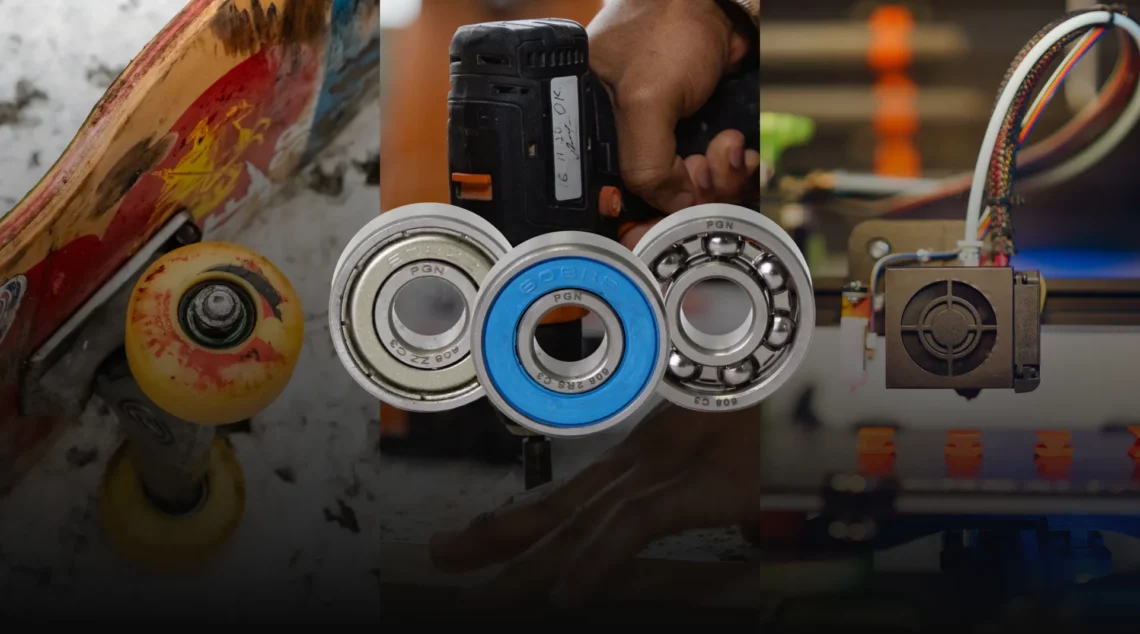
At just 8 mm × 22 mm × 7 mm, the 608 bearing may be small, but it’s one of the most versatile bearing sizes used across recreational, electrical, mechanical, and industrial applications.
You may recognize it as a common skateboard bearing, but its applications extend far beyond skate wheels.
The same compact dimensions that make the 608 useful in skateboards and roller skates also make it suitable for small electric motors, power tools, fans, automated systems, and other compact rotating equipment.
Let’s look at what makes the 608 bearing so versatile, where it is commonly used, and when a 608-ZZ may be the right configuration for your application.
What Is a 608 Bearing?
The 608 is a deep groove ball bearing with standard dimensions of:
- Inner diameter (bore): 8 mm
- Outer diameter: 22 mm
- Width: 7 mm
This is commonly expressed as a 608 8x22x7 mm bearing.
Deep groove ball bearings are designed to minimize friction while supporting primarily radial loads and some axial loads, making the design suitable for a broad range of rotating applications.
The compact dimensions of the 608 make it particularly useful when space is limited but smooth rotational movement is still required.
Why Is the 608 Bearing So Widely Used?
Several characteristics contribute to the versatility of the 608 bearing.
Compact Dimensions
With an outer diameter of only 22 mm and a width of 7 mm, the 608 fits into relatively small assemblies.
Low-Friction Rotation
Its deep groove design allows smooth rotation with relatively low friction, which is valuable in applications involving repeated or high-speed movement.
Versatile Design
Depending on the configuration, 608 bearings can be used in applications ranging from wheels to electric motors and mechanical equipment.
Multiple Closure Options
The 608 bearing is available in open, shielded and sealed configurations, allowing users to select the level of protection and friction appropriate for the operating environment.
Common 608 Bearing Applications
So, what is a 608 bearing actually used for?
Here are some of its most common applications.
Skateboards and Longboards
The 608 is probably best known as a skateboard bearing.
Its compact 8x22x7 mm dimensions fit standard skateboard wheels, where bearings need to provide smooth rotation while handling repeated movement and radial loading.
The same size is also commonly found in similar wheeled recreational equipment.
Roller Skates and Inline Skates
Like skateboards, many roller skate and inline skate wheel assemblies use 608-size bearings.
Low friction and compact dimensions make the bearing suitable for wheel applications where smooth rotation is essential.
Small Electric Motors
The 608 bearing can also be found in small electric motors.
In these applications, bearings support rotating shafts while helping minimize friction and maintain smooth movement.
Power Tools
Compact bearings are used throughout many types of power tools and mechanical equipment.
Depending on the tool design, 608 bearings can help support shafts and other rotating components while allowing operation at relatively high rotational speeds.
Always check the equipment manufacturer’s bearing specifications before selecting a replacement.
Fans and Rotating Equipment
Fans and similar equipment depend on smooth shaft rotation.
The compact size and low-friction characteristics of a 608 bearing can make it suitable for certain fan motors and other small rotating assemblies.
Automation and Mechanical Systems
The 608 isn’t limited to consumer products.
Its small footprint also makes it useful for certain:
- Conveyor components
- Automation systems
- Guide rollers
- Small machinery
- Mechanical assemblies
- Rotating equipment
The exact bearing configuration should always be selected according to load, speed, contamination, temperature and other operating conditions.
608-ZZ vs. 608-2RS vs. Open 608 Bearings
Understanding the 608 bearing size is only part of selecting the correct bearing.
The closure type can make a significant difference.
| Feature | 608-ZZ | 608-2RS | 608 Open |
| Closure | Metal shields | Rubber seals | Open |
| Contaminant protection | Moderate | Higher | Minimal |
| Friction | Low | Slightly higher | Very low |
| Lubricant retention | Good | Very good | Depends on application |
| Typical environment | Cleaner/drier | Dustier or exposed | Controlled/clean |
When to Choose 608-ZZ
A 608-ZZ has metal shields on both sides of the bearing.
The shields help retain lubricant and reduce the entry of larger contaminants while maintaining relatively low friction.
This makes ZZ bearings useful for many applications where speed and contaminant protection need to be balanced.
When to Choose 608-2RS
A 608-2RS uses rubber seals on both sides.
The seals generally provide greater protection against dust, dirt and moisture than metal shields, but their contact with the bearing rings can result in additional friction.
They can therefore be advantageous in more contaminated operating environments.
When to Choose an Open 608 Bearing
An open bearing does not have shields or seals covering the rolling elements.
This can minimize seal-related friction and provides direct access for lubrication, but it also leaves the internal components more exposed to contamination.
Open bearings are therefore better suited to controlled environments or assemblies where external protection is already provided.
What Does C3 Mean on a 608 Bearing?
Another specification you may encounter is C3 clearance.
Internal bearing clearance refers to the amount of movement available between the bearing’s internal components before installation.
A C3 bearing has greater internal clearance than a standard-normal-clearance bearing.
Why would additional clearance be necessary?
During operation, heat and interference fits can reduce the bearing’s effective internal clearance. In appropriate applications, C3 clearance provides additional room to accommodate these operating conditions.
However, C3 does not simply mean “better” or “higher quality.” The correct internal clearance depends on the application, operating temperature, speed, fits and loads.
The PGN 608-ZZ is offered with C3 internal clearance.
HWhen Should You Choose a 608-ZZ Bearing?
A 608-ZZ can be a good option when your application requires:
- 8x22x7 mm dimensions
- Low-friction rotation
- Metal shields on both sides
- Protection from larger contaminants
- Lubricant retention
- C3 internal clearance
- Suitability for relatively high rotational speeds
But dimensions alone aren’t enough.
Before replacing a bearing, compare the bearing size, closure type, internal clearance, load requirements, operating speed and environment with the specifications required by your equipment.
How to Find the Right 608 Bearing
Start by checking the marking on the existing bearing and your equipment specifications.
A bearing marked simply 608, for example, does not necessarily have the same closure configuration as a 608-ZZ or 608-2RS.
Pay particular attention to:
- Bearing dimensions
- Shield or seal configuration
- Internal clearance
- Operating speed
- Load requirements
- Operating environment
Matching these specifications helps ensure that the replacement bearing is appropriate for the intended application.
Explore PGN 608 Ball Bearings
PGN offers multiple 608 bearing configurations for different operating environments and requirements, including 608-ZZ, 608-2RS and open 608 bearings.
The PGN 608-ZZ Ball Bearing features 8x22x7 mm dimensions, double metal shields, chrome steel construction, pre-lubrication and C3 internal clearance.
Whether you’re replacing bearings in rotating equipment, electric motors, power tools, wheels or other mechanical systems, understanding the application first will help you select the right 608 configuration.
Explore PGN’s 608 Ball Bearings and choose the configuration that best fits your application.